What Does 585 Mean on Gold Jewelry? The Complete Guide
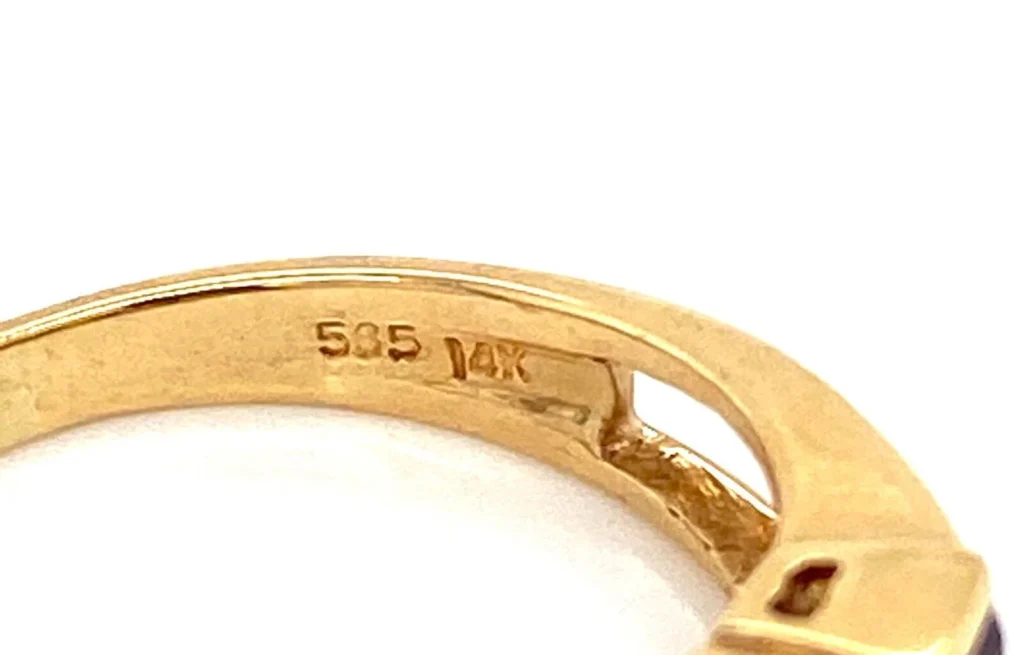
You pick up a gold ring, necklace, or bracelet and notice a tiny three-digit stamp inside the band: 585. What does it mean? Is it real gold? And what is it actually worth today?
These numbers are not random. They belong to an internationally standardized system called the millesimal fineness system, and once you understand how it works, you can read any gold hallmark in the world with confidence. This guide covers everything, from the metallurgy behind the number to how to calculate your piece’s exact scrap value in minutes.
585 = 14 karat (14K) gold, 58.5% pure gold by mass. The remaining 41.5% is alloy metals such as silver, copper, zinc, or palladium. It is the most widely used gold purity in US fine jewelry, holds genuine value, and is accepted by all gold buyers worldwide.
What Does 585 Mean on Gold Jewelry?
The number 585 is a purity hallmark stamped onto gold jewelry to show it contains 585 parts per 1,000 of pure gold, or 58.5% gold by mass. This system is called millesimal fineness, used internationally as a precise, language-neutral alternative to the karat system.
In the karat system, gold purity is measured in parts per 24. Pure gold is 24 karat. Fourteen karat gold contains 14 parts gold out of 24, which equals 58.33%, rounded up to 58.5% in fineness notation, giving us the 585 stamp.
The Conversion Formula: Karat ÷ 24 × 1,000 = Fineness Mark. Example: 14 ÷ 24 × 1,000 = 583.3, rounded to 585.
You may also see a 583 stamp on older American jewelry (pre-1980s) or Eastern European pieces, a different rounding convention, but the same 14 karat gold with identical value.
As the World Gold Council explains, fineness expresses purity in parts per thousand, universally readable regardless of language, making it the preferred standard across Europe and international trade.
Complete Gold Fineness & Karat Reference Chart
Here is every major fineness mark you might encounter on jewelry around the world:
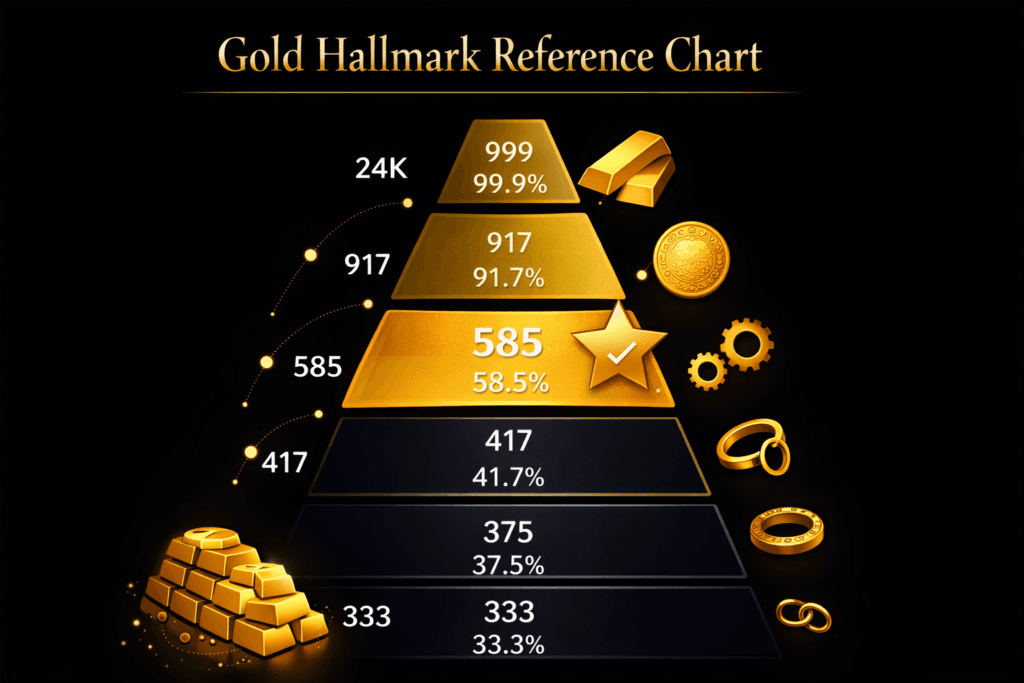
| Fineness Mark | Karat | Pure Gold % | Common Use |
|---|---|---|---|
| 333 | 8K | 33.3% | Some European budget markets |
| 375 | 9K | 37.5% | Popular in UK, Australia and Ireland |
| 417 | 10K | 41.7% | Minimum legal standard in the US |
| 585 (or 583) ✓ | 14K | 58.5% | Most popular in the US, everyday fine jewelry |
| 750 | 18K | 75.0% | Luxury and fine jewelry, dominant in Europe |
| 916 / 917 | 22K | 91.6% | Bridal and ceremonial jewelry in South Asia |
| 999 | 24K | 99.9% | Investment bars, coins, and bullion |
In the US, the Federal Trade Commission (FTC) advises consumers to look for the karat quality mark and a manufacturer’s trademark together on any gold jewelry.
The Metallurgy Behind 585 Gold: What Is the Other 41.5%?
Pure gold (999 fineness) has a Vickers hardness of approximately 25 HV, so soft it would bend with normal wear. By introducing carefully selected alloy metals, jewelers create an intermetallic compound with dramatically improved mechanical properties, including higher tensile strength and better resistance to deformation.
The most common alloy additions in 585 gold:
- Silver: Increases ductility, contributes to white and green-gold tones
- Copper: Adds hardness, dominant in rose gold alloys for the blush-pink color
- Zinc: Improves castability and grain refinement, reduces porosity
- Palladium: Bleaches yellow color for white gold, hypoallergenic and highly stable
- Nickel: Also used in white gold for color-bleaching, lower cost but carries allergy risk
The resulting 585 alloy typically reaches a Vickers hardness of approximately 120–155 HV, significantly harder than pure gold and well-suited for rings and bracelets that experience regular friction.
According to the World Gold Council, the alloying process allows jewelers to produce gold in a range of colors: yellow, white, and rose, all while maintaining the same 58.5% gold content.
The Three Colors of 585 Gold
All three varieties below carry the same 585 hallmark and contain 58.5% gold. The color is determined entirely by which alloy metals are blended with the gold.
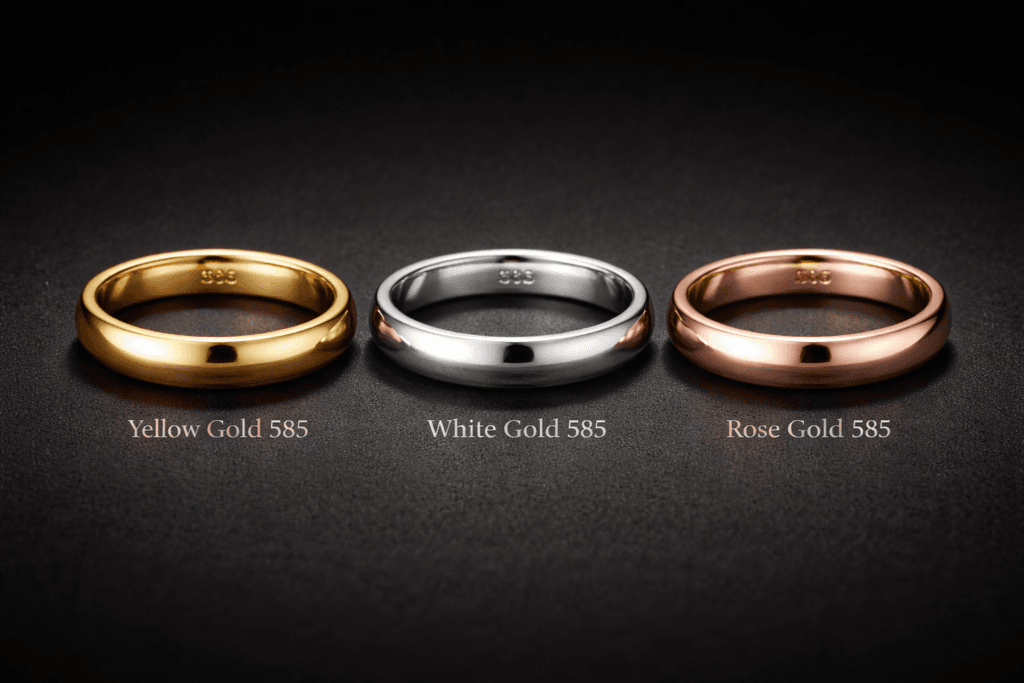
| Type | Alloy Composition | Notes |
|---|---|---|
| Yellow Gold | Gold, silver, copper | The classic warm tone. Does not fade or change color over time. The most traditional choice. |
| White Gold | Gold + palladium or nickel | Bleaches the natural yellow tone. Usually rhodium-plated for a bright silver-white finish. Re-plating may be needed after years of daily wear. |
| Rose Gold | Gold + ~33% copper | Higher copper content produces the distinctive blush-pink color. Naturally slightly more scratch-resistant due to the copper content. |
585 Gold & Skin Sensitivity: Nickel vs Palladium in White Gold
This is one of the most important questions about 585 gold, and one almost no other guide addresses properly. If you have sensitive skin or a history of metal allergies, the alloy composition matters as much as the gold content.
Pure gold is hypoallergenic. The reaction risk comes from the metals blended with it. In 585 white gold specifically, two metals are used to achieve the white color, and they behave very differently on skin:
| Alloy Metal | Used In | Skin Reaction Risk | Verdict |
|---|---|---|---|
| Nickel | Budget white gold | High: #1 cause of contact dermatitis from jewelry | Avoid if sensitive skin |
| Palladium | Premium white gold | Very low: considered hypoallergenic | Safe for most people |
| Copper | Rose gold | Low: can cause green discoloration occasionally | Generally well-tolerated |
| Silver | Yellow gold | Very low | Generally safe |
Tip for Sensitive Skin: When buying 585 white gold, always ask whether it uses nickel or palladium as the bleaching agent. Nickel-free labeling is not always standardized, confirm directly with the jeweler. Yellow or rose 585 gold is typically the safest option for those prone to metal allergies.
Is 585 Gold Real? How to Verify Authenticity
Yes, a 585 stamp means real gold. However, since 14K is the most widely sold gold purity, it is also the most frequently counterfeited. Here is how to verify what you actually have.
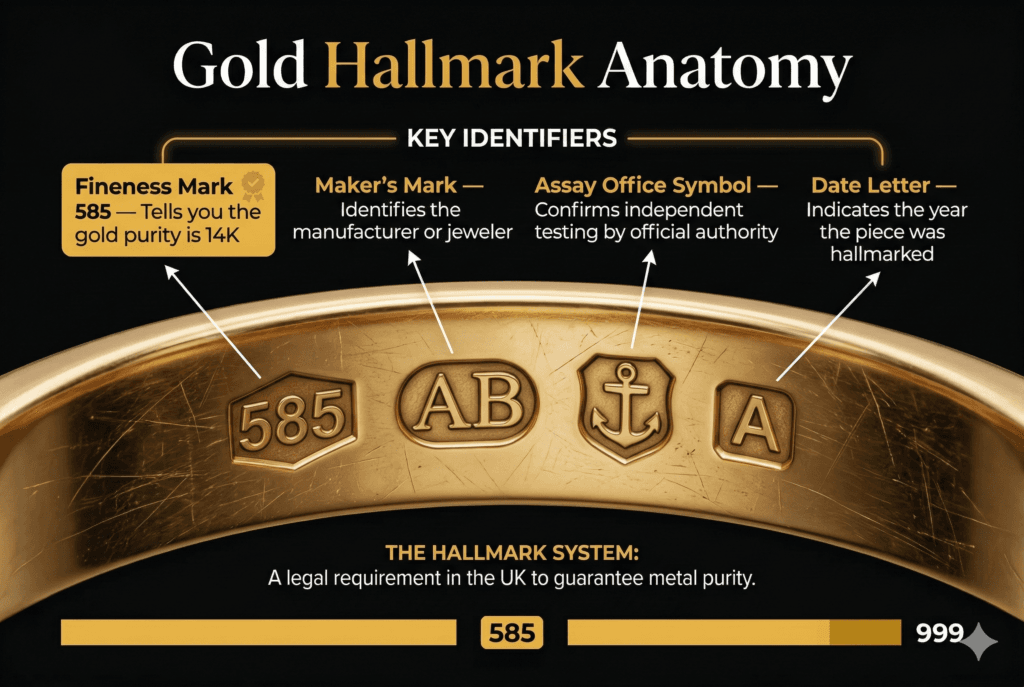
As the World Gold Council notes on hallmarking, gold hallmarks are one of Europe’s earliest forms of consumer protection, dating back to the 13th century.
- Check for accompanying hallmarks: Genuine pieces carry a maker’s mark and, in the UK, an assay office symbol (anchor for Birmingham, leopard’s head for London).
- Magnet test: Real gold is non-magnetic. A strong pull toward a magnet indicates a base metal core.
- Look for wear-through: On high-friction areas, fake gold-plated pieces reveal the base metal underneath. Solid 585 gold will not show through.
- XRF testing: An X-Ray Fluorescence gun provides exact metal composition non-destructively in under 10 seconds.
- Acid test: A small scratch with a nitric acid solution produces a color-specific reaction for 14K gold.
For a full breakdown of every home testing method, see our guide on how to tell if gold is real.
How Much Is 585 Gold Worth? Melt Value Explained
The value of a 585 gold piece is determined by three variables: its weight, its purity (58.5%), and the live spot price of gold. Together these produce the melt value, the raw monetary worth of the gold content.
Melt Value Formula: Weight (grams) × 0.585 × Current Spot Price per gram = Melt Value. Example: 10g × 0.585 × $95 = $555.75
- Condition is irrelevant: A bent or broken 585 piece contains the exact same gold as a perfect one.
- Buyers do not pay full melt value: They deduct refining costs and operating margin. Expect offers at a percentage of melt value.
- Notable pieces may exceed melt value: Designer or vintage jewelry can sell for a premium on secondary markets.
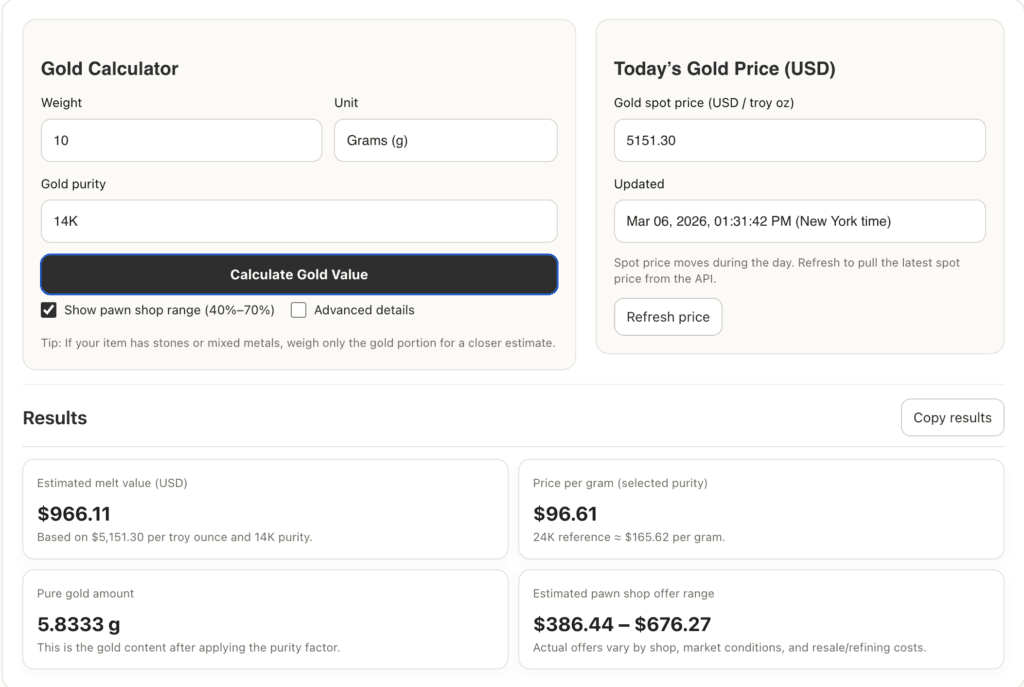
Enter weight and purity and get the live melt value, actual gold content, per-gram rate, and estimated pawn shop offer in seconds. Free, no sign-up required.
Try the Free Calculator →585 vs 750 vs 417: Which Gold Is Right for You?
| Feature | 417 (10K) | 585 (14K) | 750 (18K) |
|---|---|---|---|
| Pure Gold % | 41.7% | 58.5% | 75.0% |
| Vickers Hardness | ~175 HV | ~150 HV | ~120 HV |
| Durability for daily wear | Very hard | Hard: ideal | Softer |
| Color richness | Lighter yellow | Warm medium yellow | Rich deep gold |
| Tarnish resistance | Lower | Good | Very good |
| Price point | Budget | Mid-range | Premium |
| Skin sensitivity risk | Higher (more alloy) | Moderate | Lower |
| Best for | Budget jewelry | Engagement rings, everyday bands | Luxury showpieces |
For everyday durability, 585 is the clear choice. As the World Gold Council confirms, 14 karat is the most popular gold standard in the United States.
Is 585 Gold Pawnable? What Will a Pawn Shop Offer?
Yes, pawn shops widely accept 585 gold. It is among the most recognizable gold purities. However, pawn shop offers are typically the lowest in the gold-buying market.
- Starting point: Pawn shops calculate melt value using weight, purity, and current spot price
- Typical offer range: 40% to 70% of melt value, industry average is approximately 50%
- Loan option: Many pawn shops allow you to use your gold as collateral for a short-term loan rather than selling outright
- Alternatives: Local jewelers, coin shops, and online gold buyers often offer higher percentages. Always compare two or three offers
Before You Visit a Pawn Shop: Know your melt value in advance using the free calculator. Walking in with your number gives you a clear negotiating reference point. See also: how much do pawn shops actually pay for gold.
For guidance on selling gold safely, the FTC’s consumer guide to buying precious metals recommends verifying both the karat quality mark and the manufacturer’s trademark, and comparing offers from multiple buyers.
The US Gold Labeling Rules: What the FTC Requires
In the United States, gold jewelry labeling is governed by the FTC’s Guides for the Jewelry, Precious Metals, and Pewter Industries. These rules directly affect how 585 stamps are used and what they legally mean.
- Any item stamped with a karat quality mark must also display the manufacturer’s trademark. A standalone 585 stamp without a maker’s mark does not meet FTC requirements.
- The actual gold content must not vary by more than 3 parts per 1,000 from the stated fineness. A 585 stamped piece must contain at least 582 parts per 1,000 pure gold.
- Gold-plated items cannot legally be stamped as solid gold. Terms like “gold filled” and “gold electroplate” have specific legal definitions.
- Under the FTC’s revised 2018 Guides, any gold alloy may be marketed using gold terms as long as the karat fineness is accurately disclosed.
How to Care for 585 Gold Jewelry
- Clean gently: Warm water, a drop of mild dish soap, and a soft toothbrush. Rinse and dry with a lint-free cloth.
- Avoid chlorine and bleach: Pool water and household cleaners can degrade alloy metals and dull the finish.
- Store separately: Use individual soft pouches or compartmentalized boxes to prevent scratching.
- Re-plate white gold as needed: Rhodium coating wears over years of daily wear. A jeweler can re-plate for a modest fee.
- Annual inspection: Have prongs, clasps, and stone settings professionally checked once a year.
Frequently Asked Questions
Yes. 585 and 14K are two expressions of identical gold purity, 58.5% pure gold. They are fully interchangeable in value and meaning.
Effectively yes. The 583 stamp appears on older American and some Eastern European jewelry. Both indicate 14 karat gold and carry identical value.
Solid 585 gold should not cause greening under normal conditions. Greening typically indicates gold plating over a base metal, not solid 585 gold.
Multiply weight in grams by 0.585, then by the current gold spot price per gram. Or use the free live calculator for an instant result including an estimated pawn shop offer.
Yellow and rose 585 gold are generally safe. White 585 gold can contain nickel, the leading cause of jewelry-related contact dermatitis. Always ask whether the white gold uses nickel or palladium before buying.
For daily durability, 585 wins due to higher Vickers hardness. For color richness and higher gold content, 750 (18K) is preferred. For selling, 750 commands a higher melt value per gram.
Under FTC guidelines, a karat quality mark must be accompanied by a manufacturer’s trademark to be legally compliant in the US. A lone 585 stamp warrants closer verification, ideally via XRF testing.
Pawn shops, local jewelers, coin dealers, and online gold refiners all accept 585 gold. Online refiners and jewelers typically pay the highest percentage of melt value. See our gold selling guide for a full comparison.
Final Thoughts
That three-digit 585 stamp carries more information than most people realize. It tells you the gold content, the alloy composition, the expected durability, and when combined with today’s live spot price, the exact monetary value of the piece in your hand.
Whether you are buying, inheriting, or selling 585 gold jewelry, understanding the hallmark puts you in full control. You know what you have, how to verify it, and how to value it fairly.
Know what your gold is worth before anyone else does. Free. Instant. No sign-up.
Calculate My Gold Value Now →